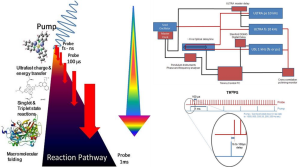
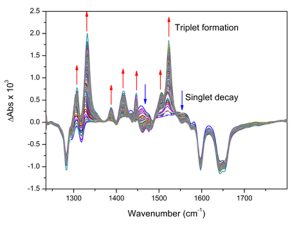
Time-resolved absorption spectra provide information on change in molecules through triggering some change (with a pump pulse) and then interrogating the sample over time through electronic or vibrational spectroscopy (with one or more probe pulses). Pump and probe beams are focused onto a sample, and the probe beam spectrum is measured at high-repetition rate to observe changes to the absorption spectrum.
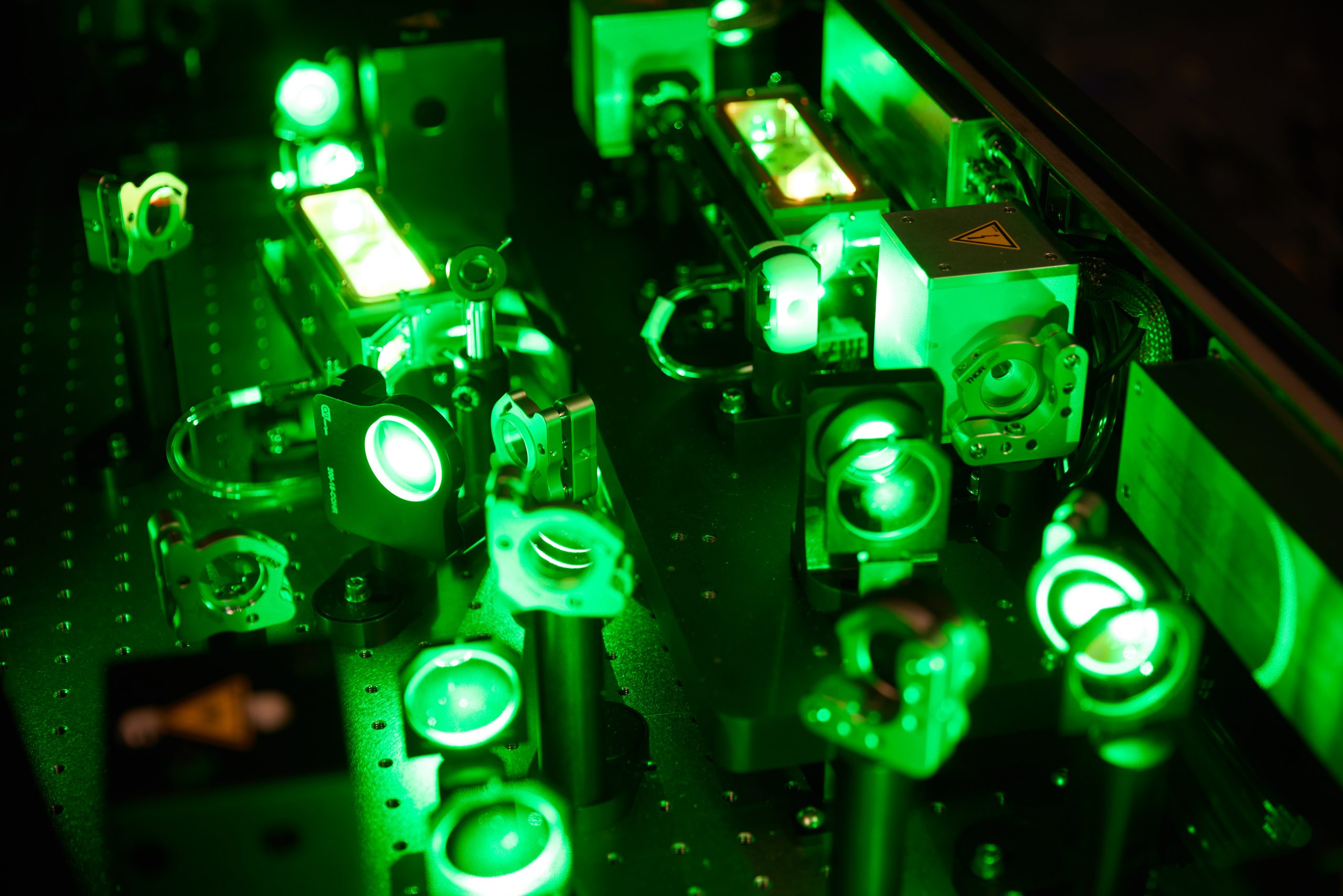
Pump pulses
The facility provides pump pulses ranging from femtoseconds to nanoseconds in duration. Femtosecond pulses allow one to trigger the process of interest on timescales relevant to molecular dynamics processes. Nanosecond pulses are available for use in cases where high energies (>10µJ) are required and femtosecond pulses may introduce unwanted non-linear effects or are not energetic enough.
We can trigger processes with:
- electronic excitation: UV to NIR pulses, for example, triggering photolysis
- IR excitation: specific vibrational mode excitation
- temperature jump: nanosecond pulses of >100µJ allow temperature changes of ten to 100s of degrees
Typical pump pulse properties
The duration of the pump pulse can be either femtoseconds or nanoseconds. Femtosecond pulses are typically <200fs, but shorter available on discussion. These ultrafast pulses allow us to trigger the process of interest on timescales relevant to molecular dynamics processes. Nanosecond pulses are available for use in cases where high energies (>10µJ) are required and femtosecond pulses may introduce unwanted non-linear effects or are not energetic enough.
The energy of the pump pulse is available in nanojoules to millijoules, depending on source (OPA, harmonics or OPO). The wavelength can range between 200 to 16,000nm.
Probe pulses
A range of broad spectral bandwidth probe pulses enable probing of sample absorption from UV to IR.
Typical probe pulse properties
The probe pulses are typically <100fs, but shorter are available on discussion. These ultrafast pulses allow one to probe the process of interest on timescales relevant to molecular dynamics processes.
The wavelengths offered are:
- UV to blue continuum, 300 to 500nm
- green to red continuum, 500 to 950nm
- near IR continuum
- OPA outputs, 1.5 to 16µm, broad bandwidths varying across the spectrum (typically >400cm-1 accessible)
The stable probe beams are used to measure extremely small changes. Measuring ΔOD down to 10-6 is possible but dependent on many things such as sample transmission properties and how frequently the sample can be pumped (up to 50kHz).
Timing control
The facility provides combines traditional femtosecond to nanosecond (<10fs to 15ns) timing control between pump and probe pulses using translation stages, but also combines this with laser seeding control to step out to microseconds and high-repetition rate probing to extend this to milliseconds and beyond on a single instrument using our time-resolved multiple probe spectroscopy (TRMPS) method.
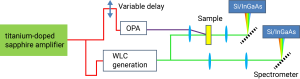
Example experimental systems
The following are description of the experimental systems.
100kHz transient spectroscopy system
A 100 kHz Time-Resolved Multiple-Probe Femtosecond to Second Infrared Absorption Spectrometer
A 100 kHz Pulse Shaping 2D-IR Spectrometer Based on Dual Yb:KGW Amplifiers
Temperature jump experiments
Time-Resolved Temperature-Jump Infrared Spectroscopy at a High Repetition Rate
Laser induced temperature-jump time resolved IR spectroscopy of zeolites
Facility overview
Ultrafast Spectroscopy at the Central Laser Facility
Time resolved multiple probe spectroscopy
Time-resolved multiple probe spectroscopy
Older experimental systems