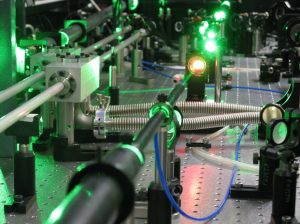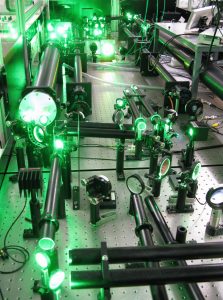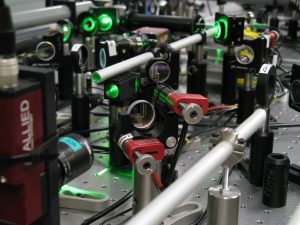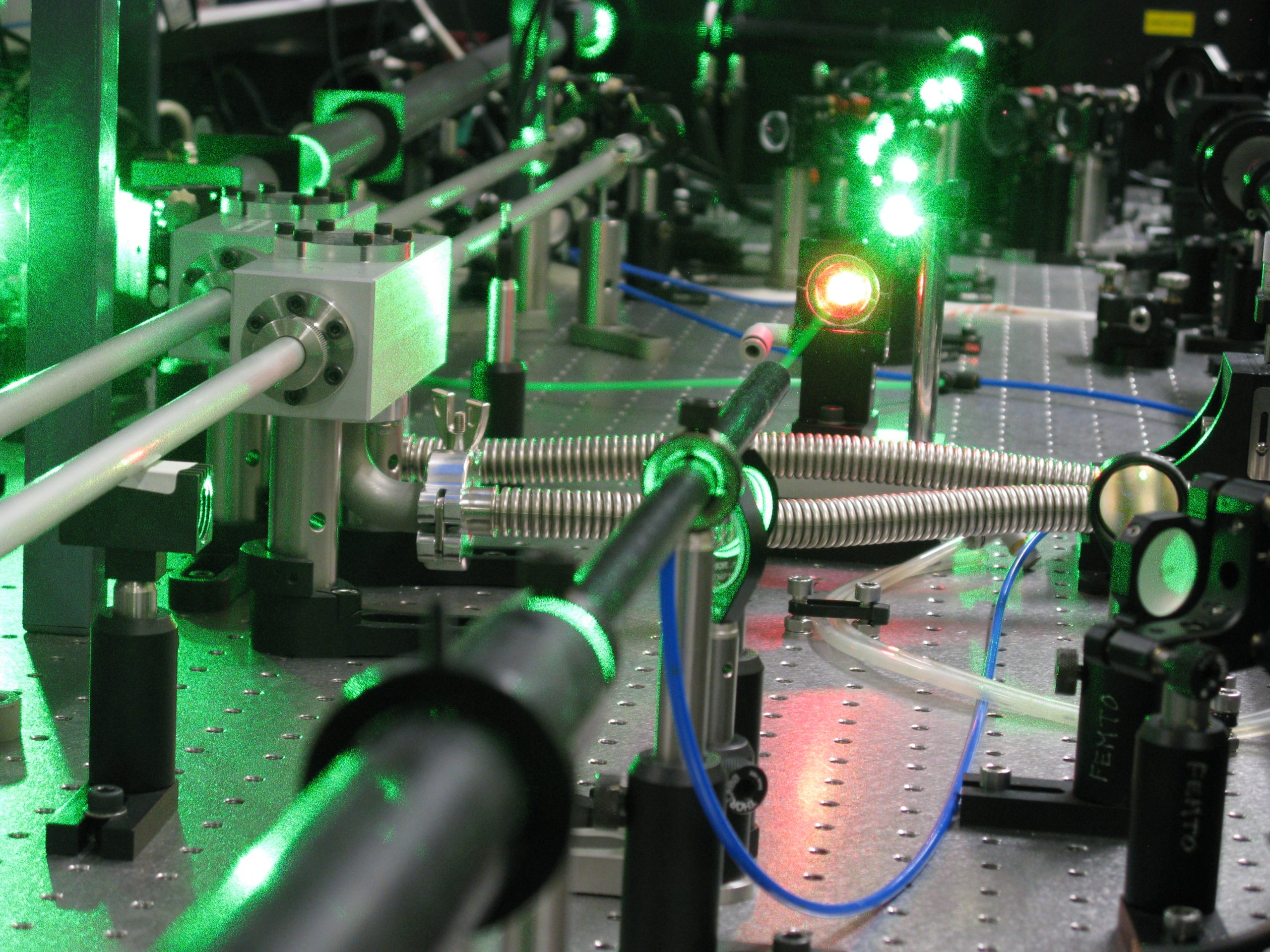
The Gemini front end system, similar to other high power lasers, has MOPA (Master Oscillator – Power Amplifier) architecture. This means that a low energy, high-quality pulse is generated at the start of the laser chain and amplified to successively greater energies in a sequence of amplifiers. The source pulses are extremely short, so the technique of chirped pulse amplification is used to avoid distortion of the pulses and damage to the laser during amplification.
You may hear Gemini’s front end and Target Area 2 (TA2) being referred to as “Astra”. This is because Gemini was built upon a pre-existing CLF laser facility called Astra.
The front end consists of an ultra-short pulse oscillator that provides low-energy, high-quality seed pulses of around 12fs duration. These are slightly stretched to around 7ps in a glass block before being amplified to millijoule energy in a kHz repetition rate preamplifier. After the preamplifier, individual pulses are selected by a fast Pockels cell at a repetition rate of 10Hz.
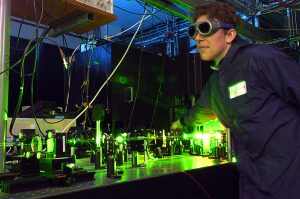
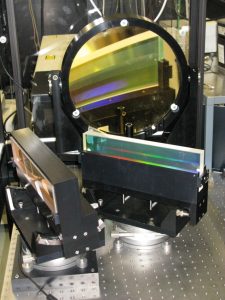
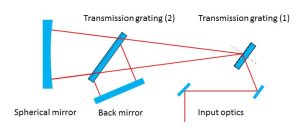
A much greater stretch is then applied, using a wavelength-dependent optical delay line. If the pulse is destined for TA2, it is stretched to 530ps, or if it is destined for Gemini, it is stretched to 1060ps. Pulses of this length can be amplified to multi-joule energies without reaching intensities that would damage optical components or cause severe distortion of the pulse. If the pulses were amplified without stretching, the resulting intensity could severely damage or even shatter optical components in the laser.
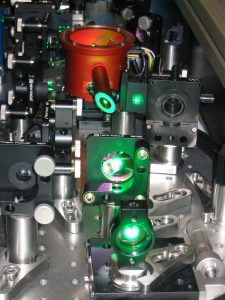
Three amplifiers are used in sequence to reach a final energy of more than 1J per pulse. Each amplifier consists of a titanium-doped sapphire (Ti:S) crystal that is pumped by pulses of green light from another laser. The green light excites the titanium ions in the crystal to a state of higher energy, a condition in which they are able to amplify the infrared light in the stretched seed pulse as it passes through the crystal.
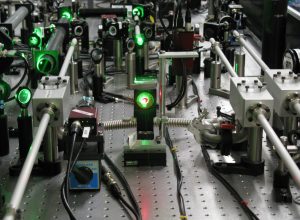
All these lasers run at 10 pulses per second and are accurately synchronised so both the pump and seed pulses arrive at the crystal at the correct times. At the output of the third amplifier, the beam with the 10Hz pulse train is separated into two beams each with a 5Hz pulse train. One beam is sent to the Gemini laser area, and the other to TA2. Attenuators are used to control the pulse energy in each beamline. For TA2, a fast-acting mechanical shutter allows the experimenters to use either the full pulse train for setup and alignment, or to select individual full-energy pulses on demand.
To aid alignment of the pulse compressors, a dual-wavelength continuous wave (CW) diode can be injected into either beam line at wavelengths of 785nm and 810nm. These are near the extremes of the pulse spectrum. Used in conjunction with alignment mirrors and imaging, the dual-wavelength beam allows the grating alignment in the pulse compressors to be optimised rapidly.
In the target area, the pulses are recompressed in vacuum to a duration of about 40fs before use. Pulses can be used at repetition rates of up to 5Hz at full energy, or at 10Hz with low energy for alignment purposes.