Time-resolved photoemission
Photoemission spectroscopy on solid samples
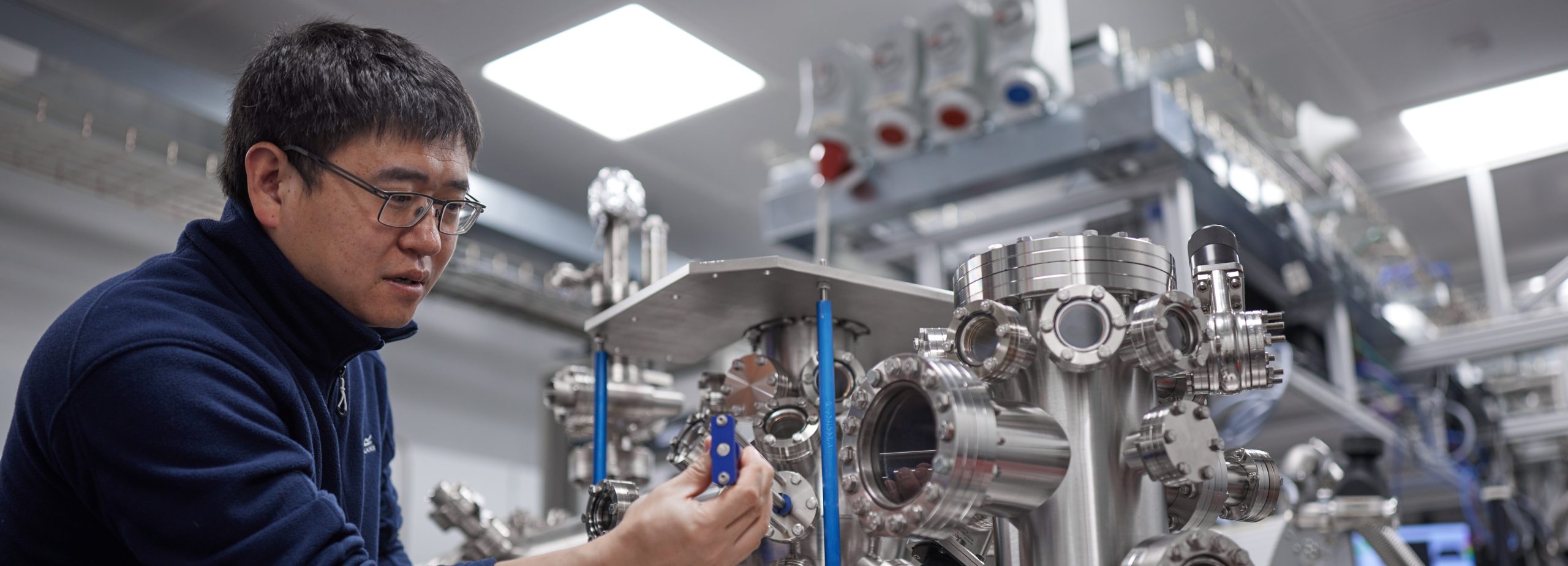
The MatSci end-station for materials science offers angle-resolved photoemission spectroscopy (ARPES) with XUV probe pulses. The analysis chamber is built around a SPECS ASTRAIOS hemispherical analyser, a SPECS METIS time-of-flight (ToF) momentum microscope, and a FeSuMa analyser by Fermiologics. The chamber offers the capabilities for pump-probe ARPES, static ARPES with a He lamp, static core-level spectroscopy with a non-monochromatised lab source and low-energy electron diffraction (LEED). The manipulator can be cooled or heated. Depending on the manipulator temperature, the pressure in the analysis chamber is in the low 10-10 to high 10-11mbar range.
A preparation chamber is connected to the analysis chamber by a gate valve. Sample exposure to non-toxic gases via a leak valve, sample cleaving and evaporation are all possible in the preparation chamber. DN40 and DN63 flanges are available for mounting evaporators. The sample garage can hold up to five samples at a time, and the load lock can hold one sample at a time. The pressure in the preparation chamber is in the low 10-10mbar range.
Requirements for samples
Sample orientation, crystallinity, and domain size
To measure k-vs.-E dispersions, the sample needs to be single-crystalline within the region of analysis (within the size of the beamspot on the sample). If more than one crystalline domain is present inside the analysis region, the measured dispersion will be the sum of the dispersions of all the domains within the region.
Cleanliness
It is important that your sample’s surface is clean, as measurements within the photon energy range are extremely surface sensitive, due to the short universal mean free path [1]. Typically, samples are prepared in ultra-high vacuum(UHV) by cleaving, annealing, de-capping, or sputtering. To ship samples externally prepared in UHV conditions, you can request to use our UHV sample suitcase. This can maintain pressures in the low 10-9 or high 10-10mbar range.
Sample quality
Photoemission linewidth becomes broad when defect density is high. Good sample quality is key to acquiring data of sufficient quality for successful analysis.
Sample electronic properties
Insulating samples are, typically, inappropriate for photoemission spectroscopy, since the photoemission process then leads to sample charging. A few exceptions exist: for example, atomically thin insulating layers on conducting substrates are sometimes feasible. If this affects your proposal, contact the beamline staff.
Sample holders
The system uses flag-style sample holders. If necessary, we can send sample plates in advance of your beamtime for mounting samples.
Pump-probe requirements
Pump photon energy and polarisation
Pump photon energy and polarisation need to be specified in the beamtime application, so the beamline can be set up in advance of the experiment. For polarisation-dependent measurements, a motorized polarizer will be inserted into the beamline and incorporated into the experimental acquisition and control software.
Pump photon energy cannot be changed without planning. If you will require more than one pump photon energy for your experiment, contact the beamline staff before submitting your proposal.
Acquisition time
Pump-probe techniques are intrinsically time consuming. Each delay time will constitute one full spectral acquisition—potentially on the time scale of up to a few hours, depending on laser repetition rate, on fluence limitations (especially to prevent space charge [2, 3]), and on statistics. It is typically feasible to probe, for example, 10 to 20 delay points selected to span the expected time scales of phenomena of interest. If polarisation dependence is to be studied, then the number of measurement points will be multiplied accordingly. Acquisition time should be considered when building a proposal.