Resonance Raman spectroscopy measures resonance-enhanced Raman spectra. This resonance-enhancement enables chromophores within molecules to be targeted with molecular specificity, by tuning the Raman pump pulse onto an electronic transition of the sample. The apparatus has a ~ 4ps time resolution with >15cm spectral resolution. The Ultra OPAs allow independent tuning of the pump and probe beams from the UV to near-IR.
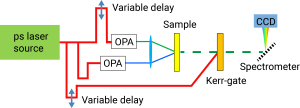
The figure shows a typical layout for a time-resolved Raman spectroscopy experiment, with OPAs driven by the 1,030nm output (red) of an ytterbium amplifier. The pump laser (blue) initiates a change within the sample, the dynamics of which are probed by a second time delayed beam (green) “probe” beam. Raman scatter (green dotted line) from the sample is collected and directed to the spectrometer with CCD detector. A Kerr-gate system driven by a time delayed third beam from the laser output can be used to remove fluorescence background from the Raman signal.
Selected publications
Please see the following paper for an application example: