X-rays are great at looking deep inside stuff and laser-driven X-rays are even better, but there is always room for improvement. In his first scientific paper as lead author, Chris Armstrong, a PhD student working at the Central Laser Facility (CLF), has come up with an ingenious way to improve the resolution of laser-driven X-ray sources that could have an impact on fundamental research, manufacturing and nuclear waste management.
If you want to see a specific object clearly with a torch, one that has a highly focused beam will do the job better than one with a diffuse beam that throws its light into night. The same is true with X-rays – the more narrow and focused the beam, the clearer the image will be. Chris Armstrong has devised an innovative method of generating an X-ray beam from a narrower spot by, somewhat counterintuitively, widening the laser pulses used to generate them.

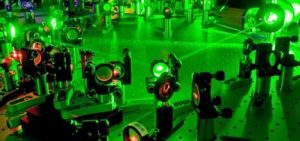
The Vulcan laser at the Central Laser Facility has been used to demonstrate a new method of generating ultra-bright X-rays.(Credit: STFC)
We are all familiar with X-rays they are used for everything from looking for broken bones in the human body to finding hidden weapons in airport baggage. These sorts of X-ray machines use the difference in charge between a cathode and an anode to accelerate electrons. In these devices, the electrons flow from the anode and collide with cathode which is made of tungsten as they collide with the tungsten, the electrons slow and change direction, which causes them to emit energy in the form of X-rays.
Laser-driven X-ray machines are the big daddies of the X-ray world. They are used for imaging things that normal X-ray sources just can’t penetrate and, because they are created by extremely fast laser-pulses, they can create those images with staggering speed and in incredible resolution. Laser-driven X-rays can create 3D images of nuclear waste barrels to check for corrosion (you don’t want nuclear waste to leak out) and to look through a jet engine to check for microscopic cracks (you really don’t want a catastrophic engine failure halfway through your flight to Magaluf).
As the name suggests, laser-driven X-ray machines use high-power lasers to generate X-rays. To create X-rays, a powerful laser pulse is fired onto a target. The laser’s electric field tears electrons from the atoms inside the target and accelerates them through it causing the electrons to emit energy in the form of high-energy X-rays, which pass out of the target and can be used for imaging.