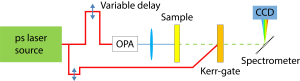
The experimental set-up developed for Kerr-gated resonance Raman spectroscopy can also be employed to record time-resolved fluorescence spectra with <4ps time resolution. The Kerr-gate is simply a fast (<4ps) optical gate. By controlling the time at which the gate opens, slices in time through the fluorescence of a sample can be recorded.
The useful transmission range of the CS2 Kerr gate is 390 to 950nm with the lower limit being set by the electronic absorption of CS2 and the upper limit set by background due to stimulated anti-Stokes emission in the medium induced by the 1030nm gating pulse. The UV coverage can be extended down to 300nm using benzene in place of CS2.
Note: This technique cannot be employed to study naturally long-lived luminescence states as the flux in 4ps slice is too weak to be detected. For this an intensified charge-coupled device (ICCD) would be employed. This is an electrical rather than optical gate and hence has a longer open time.