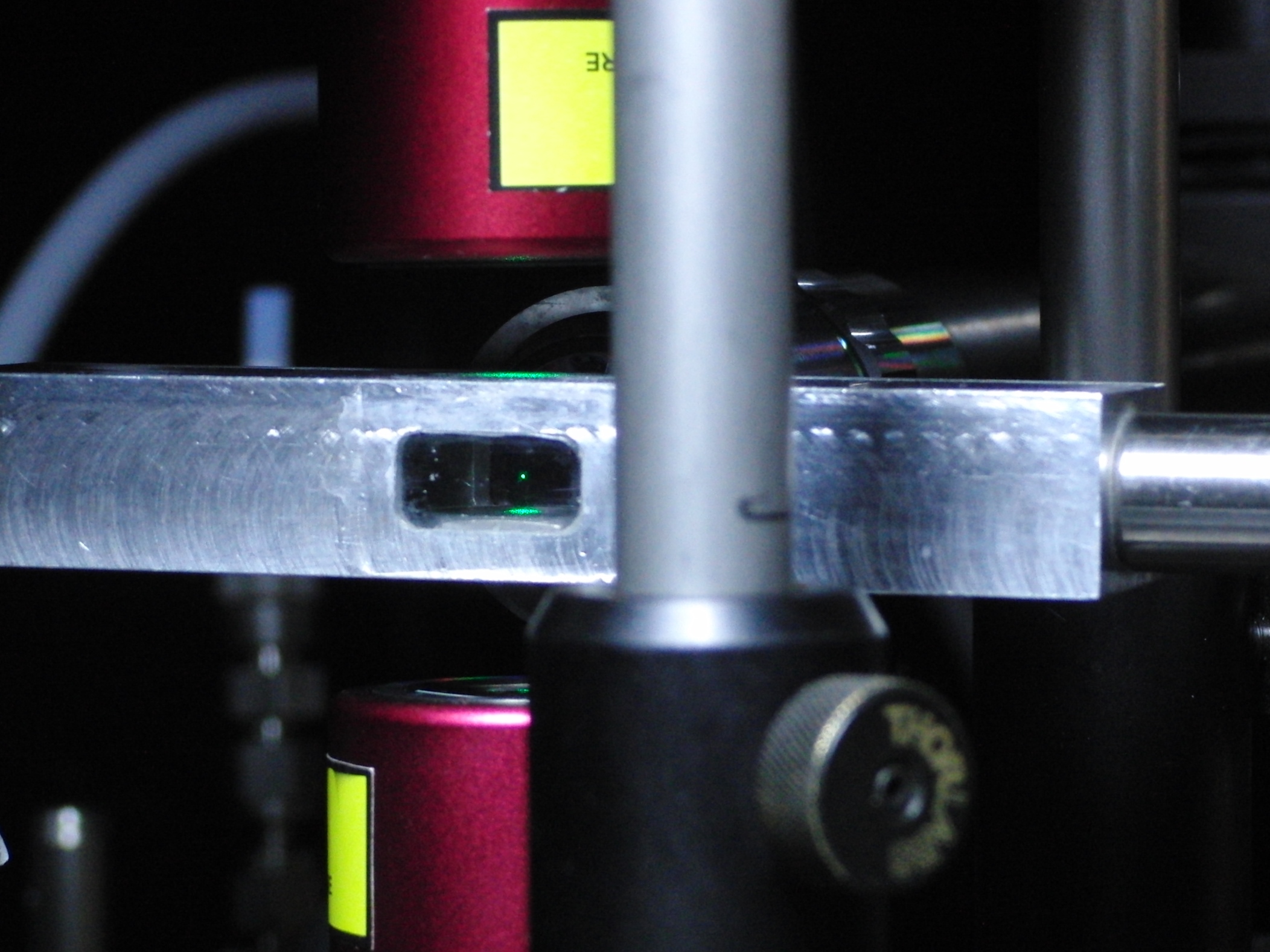
Experiment information

Optical trapping is the laser capture of microscopic particles. Typical combinations are with Force measurement, Raman spectroscopy, Mie scattering spectroscopy, Confocal microscopy and Fluorescent Lifetime Imaging microscopy. For Raman spectroscopy we frequently, but not exclusively, use the trapping wavelength as the Raman probe.

Samples are typically polymer beads, emulsions, bacteria and cells dispersed in liquids. We can also offer airborne trapping of droplets and solids below 10 microns diameter and options for atomisation and nebulisation.

Technical specifications

Laser wavelengths  Laser trapping: 488nm, 514.5nm, 532nm, 785nm, 1064nm, 1070nm. 

Raman spectroscopy: 488nm, 514.5nm, 532nm, 785nm and 1064nm. 

Broadband Mie scattering: 300nm to 1700nm. 

Compatible objective lenses  100x oil immersion, 63x oil immersion, 63x water immersion. Long working distance 100x and 50x air. 
Raman spectroscopy ranges  300 to 700nm Andor Shamrock spectrograph\Newton detectors
600 to 1000nm Acton spectrograph\PI Spec 10 detector
900 to 1700nm Isoplane spectrograph\PI NIRvana detector 
Temperature control  Water based: 5 to 90°C 

Air based: -10 to 250°C