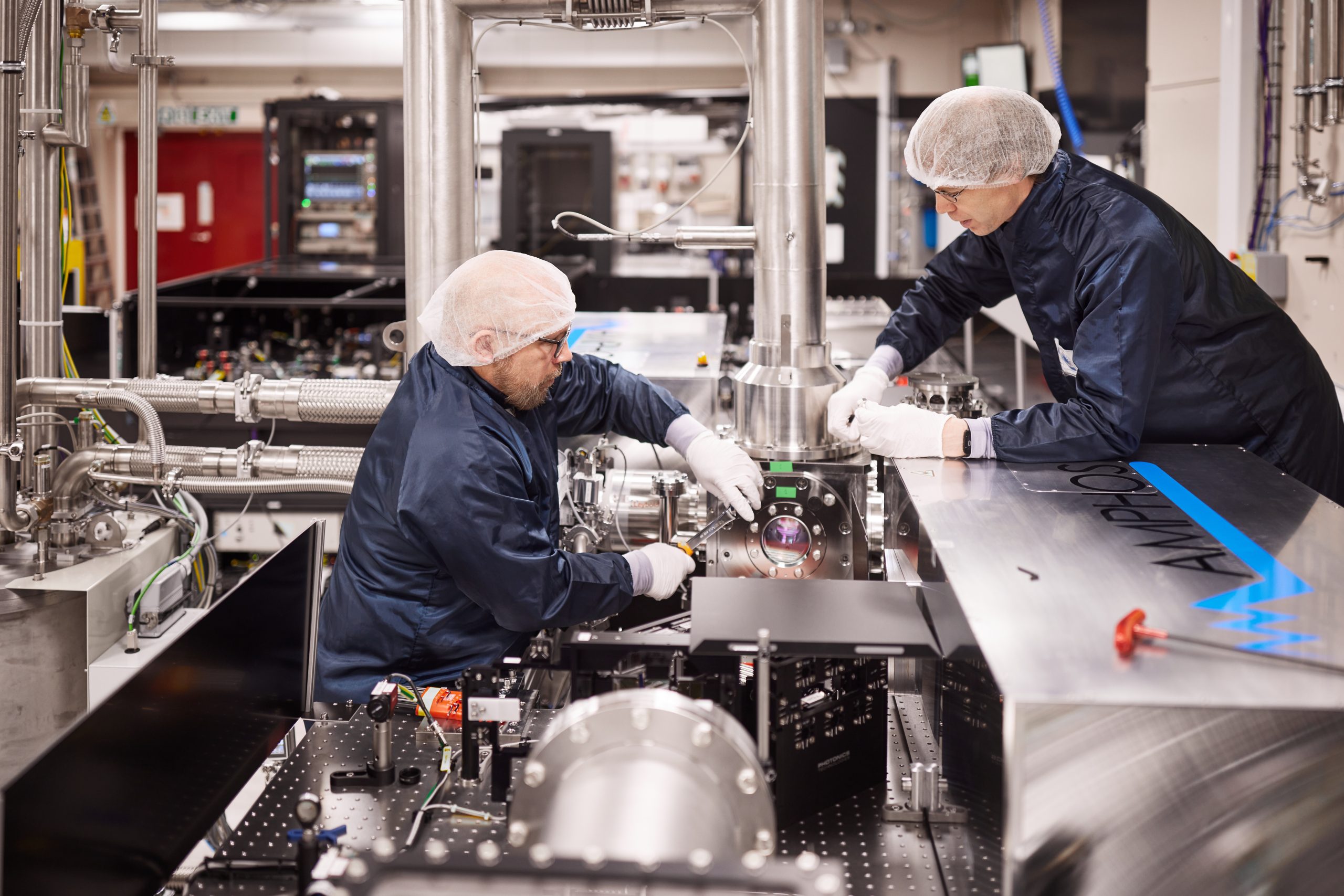
Peening is the process of repeatedly impacting a material’s surface. It is useful in industrial components as it does the following things:
- increases strength: creating a layer of compressed material near the surface makes it harder for cracks to start or grow
- improves fatigue life: parts that bend, flex or touch other parts repeatedly, like airplane wings or car springs, last longer after peening
- relieves stress: reducing internal stresses left over from manufacturing helps prevent warping or failure
- shaping and texturing: peening can be used to roughen a surface for better paint or coating adhesion, or bend and shape a large piece of material
Laser shock peening (LSP) is a modern approach to peening which is used by industries such as motorsport, aerospace, automotive, medical, and nuclear power to enhance the performance and reliability of critical components. LSP uses a high energy laser pulse to produce compressive residual stresses deep within a sample. It can increase a part’s resistance to fatigue and fracture by up to 10 times, and can even stop stress corrosion cracking in its tracks. In short, LSP helps ensure that vital parts last longer, perform better, and stay safer in demanding environments.
In traditional LSP, the sample requires an ablative layer and a confinement layer to be added to its surface to help create and direct the shockwave into the material. However, this preparation takes time.
Using the DiPOLE10 laser system, the CALTA team has developed Confinement Layer Free nanosecond Laser Shock Peening (CLF-ns-LSP), an innovative technique which eliminates the need for both an ablative layer and a confinement layer, simplifying the process. Despite this simplified process, CLF-ns-LSP can still achieve equal or even greater levels of stress within the material compared to conventional laser peening. The technique also takes full advantage of DiPOLE10’s flexibility, allowing for precise control over key laser settings such as output polarisation and custom pulse timing.
CALTA has performed multiple other LSP campaigns, exploring industrially relevant materials such as stainless steel, aluminium, and tungsten, as well as investigating the influence laser parameters can have on the residual compressive stresses produced.