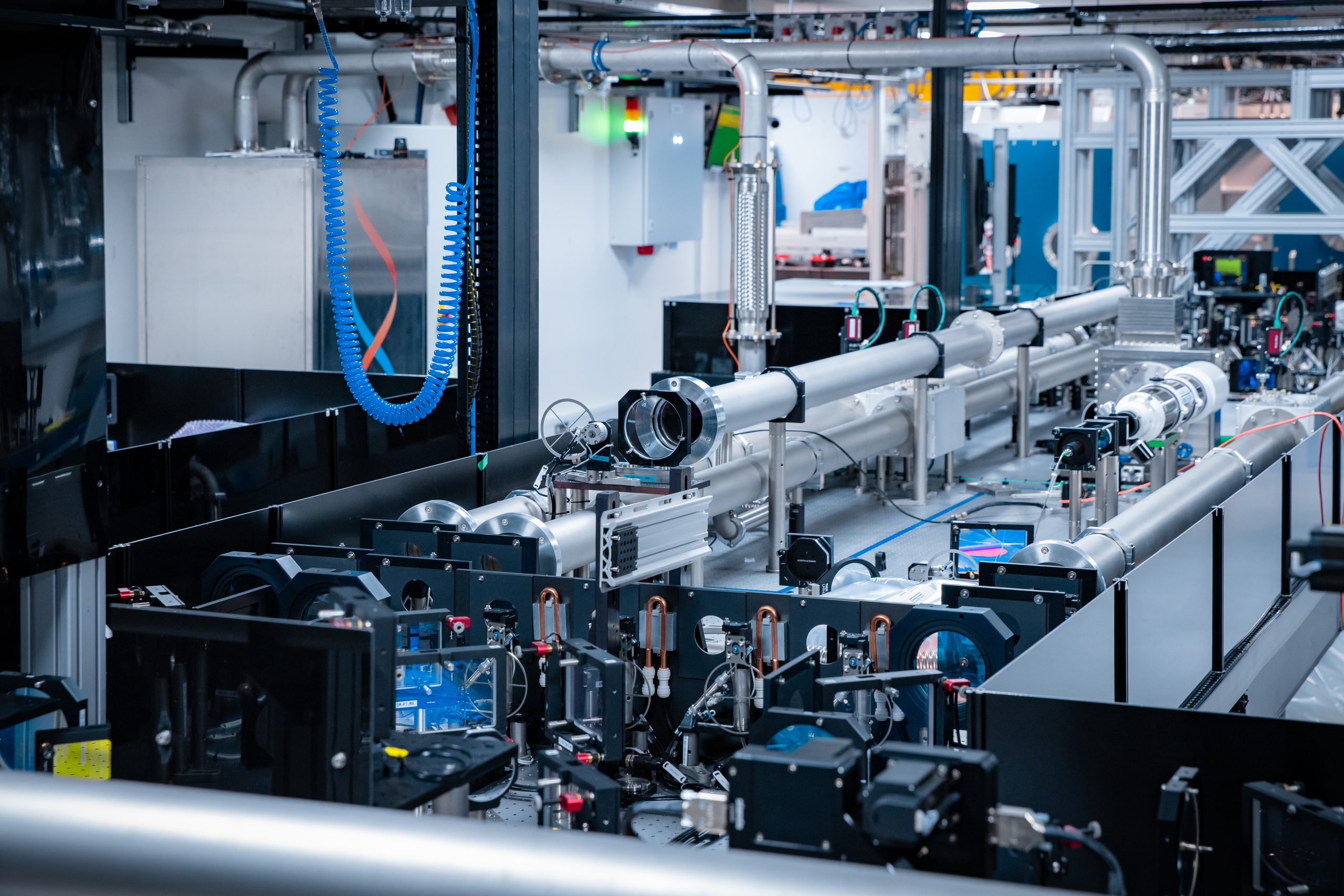
EPAC will be able to produce pulsed proton beams when focused onto solid-density targets.
The energies reached can be high and are expected to reach tens of MeV. Developments in laser proton acceleration technologies may, in time, become suitable for clinical use, and EPAC will contribute to this aim by furthering the development of laser-proton acceleration techniques.
In the short term, laser-driven proton beams can help us further understand the effects of proton beam radiation on tissues, particularly at high dose rates.
Proton beam therapy is still undergoing intense research and development, critical for preclinical evaluation of new techniques. The short pulse rates of laser-driven protons will enable studies of fast processes such as ionisations, excitations and generation of free radicals leading to DNA damage.
These studies are powerful because understanding how protons interact with cells is incomplete, with more knowledge needed on the ‘relative biological effectiveness’ (RBE) and ‘survival rates’ along the proton beam track, the spread-out Bragg peak (SOBP), and the DNA damage mechanisms. In addition, knowledge of linear energy transfer (LET) it is important to perform ‘preclinical’ evaluation of radiobiological effects of proton beams on cells.