Plasma physics
The Plasma Physics Group (PPG) provides CLF users with support in theoretical and simulation models, and assists in code development in high power laser physics research.
The fusion energy released by inertial fusion can, in-principle, be used to generate electricity: inertial fusion energy (IFE). Current estimates suggest that if IFE is to provide an economically viable source of electricity then it requires an energy gain exceeding Q=100 and an operating frequency of approximately ten capsule implosions per second. Each ignition event emits high energy neutrons which will be stopped within a lithium-containing ‘blanket’. This acts to both capture the fusion energy and create more tritium fuel. The heat in the blanket will be used to boil water, driving a steam turbine to generate electricity.
Learn more about UPLiFT, a CLF led major project focused on developing IFE
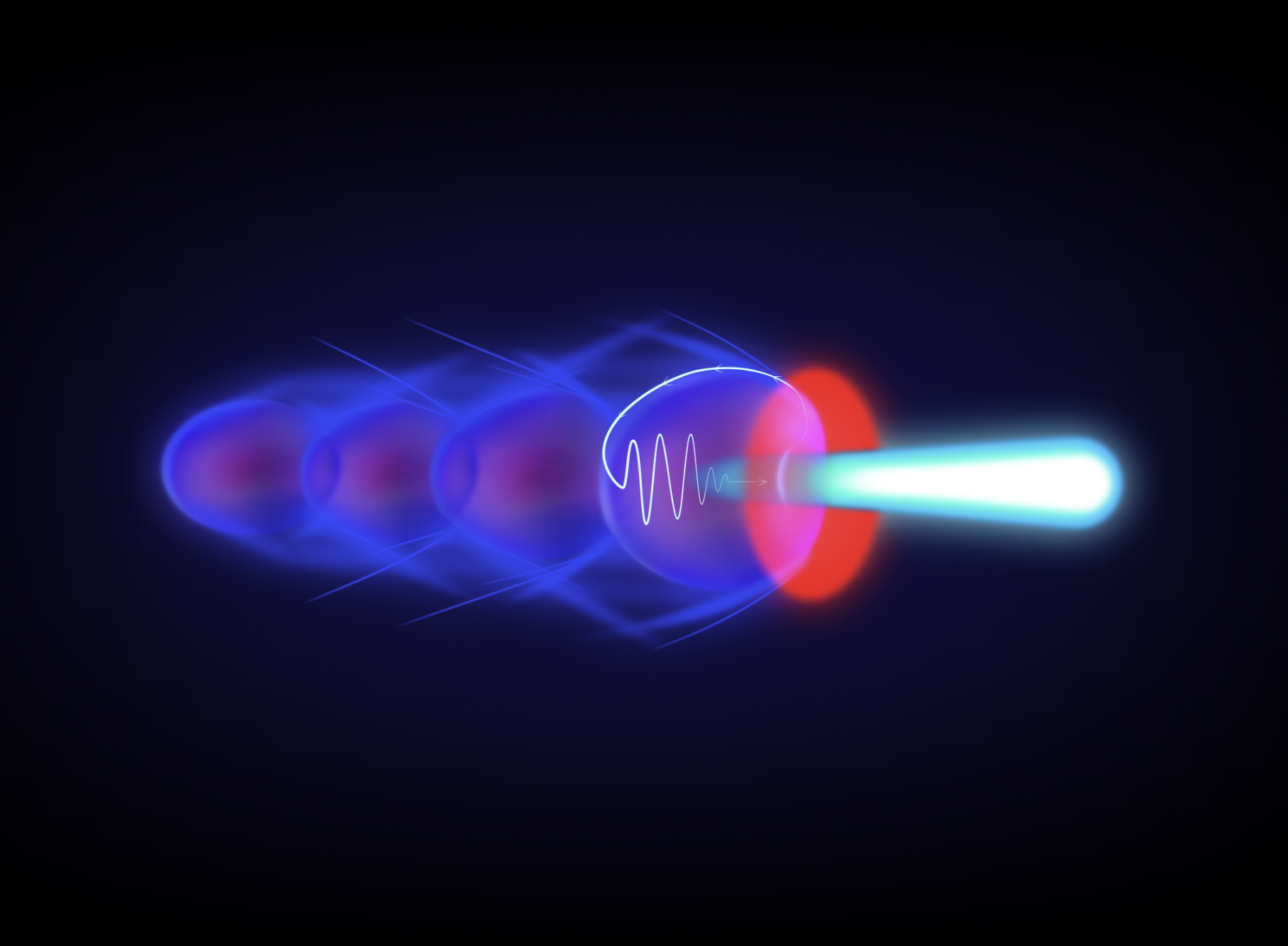
On the other hand, more indirect acceleration can occur due to the laser pulse ionising the medium and then setting up long-lived electric and magnetic fields in the resulting plasma. One of the most striking examples of this is Wakefield acceleration, which has been able to accelerate electrons to GeV energies in gas targets.
However, these electric fields also act to accelerate protons or ions at the target surface out into the vacuum. In this process protons can be accelerated to multi-MeV energies (over 100MeV has now been reported in the literature).
This is a relatively new way to produce energetic ions that has already been used in the laboratory to probe other laser-matter interactions. In the future, it may find applications ranging from Fast Ignition ICF to the treatment of tumours.
Since the background solid or plasma is resistive, a substantial electric field is established to draw the return current. In turn, Faraday’s law indicates that this must lead to the generation of magnetic fields.
There are therefore three considerations: the role of electric fields, the role of magnetic fields, and the role of collisions. The role of magnetic fields is particularly important as this determines whether a beam will filament, collimate, or not. A collimated beam will deliver a considerable amount of energy to a much smaller area. This can have considerable implications for both fast ignition and proton acceleration.
This means that the same energy gain can be obtained over a distance a thousand times as short, potentially shrinking the size of the accelerating device dramatically. In most cases, a short, intense laser pulse drives a wave in low-density plasma, and the accelerated particles “ride” this wave to obtain high energy.
This process is mainly used to accelerate electrons, but can also be used for protons and heavier positive ions. An important application of accelerated electrons is the generation of X-rays, resulting from the transverse “wiggle” motion of the electrons during their acceleration. Accelerated protons and heavier ions also have numerous applications, ranging from diagnosing plasma waves to various medical applications.
Laser-plasma instabilities happen when an intense laser beam drives a plasma wave, while the plasma wave in turn modulates the laser pulse. When these two processes reinforce each other, an instability results, and both the laser modulations and the plasma wave grow simultaneously. Research into these processes is vital to laser-driven nuclear fusion (where they are damaging and should be suppressed), and also in Raman-amplification of laser pulses (where they are beneficial and should be enhanced).
High harmonic generation of laser light in plasma targets exploits the fact that plasma is the only medium that can withstand the impact of ultra-powerful laser pulses. As the power of the harmonic radiation is proportional to that of the driving laser pulse, high harmonic generation in plasma will provide a wide spectrum of X-rays with unprecedented power. These X-rays have a wide range of applications, mainly in cutting-edge non-destructive imaging techniques.