Plasma physics

The Plasma Physics Group (PPG) provides CLF users with support in theoretical and simulation models, and assists in code development in high power laser physics research.

Long-standing expertise

The CLF Plamsa Physics Group has expertise in a number of specialist areas. These range from fundamental discovery science, to technology that could one day change the world.

Inertial fusion energy

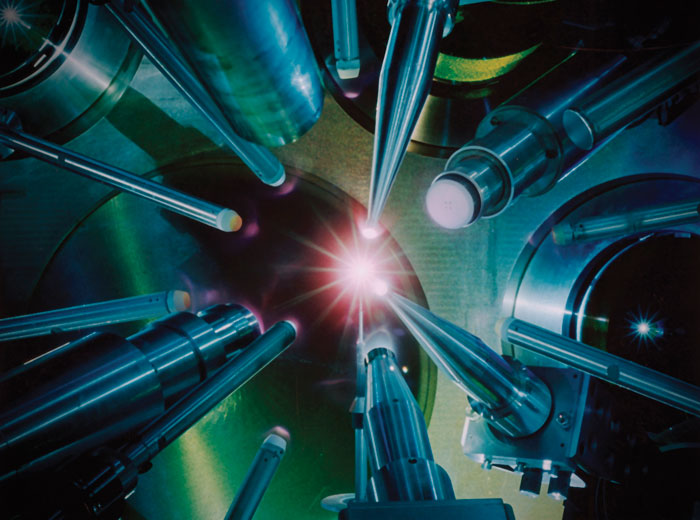
Laser-driven inertial confinement fusion uses an array of lasers to drive a spherical implosion. This compresses and heats fusion fuel to densities and temperatures exceeding those in the centre of the Sun.

If the fusion fuel collapses quickly and uniformly, the temperature and density in the centre of the implosion is enough the initiate numerous deuterium-tritium fusion reactions. These reactions initiate a fusion burn-wave which ignites a significant fraction of the fuel, causing net fusion energy release. To date, experiments on the National Ignition Facility (NIF) have released 8.5MJ of fusion energy using 2.05MJ of laser energy, a ‘gain’ (or Q) of 4.15. NIF’s achievements represent a huge scientific breakthrough because they show that fusion fuel can be ignited in such a way to produce more energy than is delivered to the fuel capsule.

The fusion energy released by inertial fusion can, in-principle, be used to generate electricity: inertial fusion energy (IFE). Current estimates suggest that if IFE is to provide an economically viable source of electricity then it requires an energy gain exceeding Q=100 and an operating frequency of approximately ten capsule implosions per second. Each ignition event emits high energy neutrons which will be stopped within a lithium-containing ‘blanket’. This acts to both capture the fusion energy and create more tritium fuel. The heat in the blanket will be used to boil water, driving a steam turbine to generate electricity.

Learn more about UPLiFT, a CLF led major project focused on developing IFE

Fast electron generation

A very characteristic feature of laser interactions with matter at high intensities is the generation of electrons travelling at nearly the speed of light. The energetic conversion factor inferred from some experiments has been above 20%.

A number of different mechanisms are attributed to this. On the one hand the acceleration could be very directly linked to the laser field itself, as the forces due to electric and magnetic fields of the laser fields at these intensities and wavelengths are sufficient to accelerate electrons into the MeV range alone.

On the other hand, more indirect acceleration can occur due to the laser pulse ionising the medium and then setting up long-lived electric and magnetic fields in the resulting plasma. One of the most striking examples of this is Wakefield acceleration, which has been able to accelerate electrons to GeV energies in gas targets.

Proton acceleration

When ultra intense laser pulses are focused onto solid targets, the burst of MeV (fast) electrons that is produced is relatively well contained in the target.

This containment is caused by very strong electrostatic fields at the target surfaces, which are generated by the charge separation that occurs when the fast electrons try to enter the vacuum.

However, these electric fields also act to accelerate protons or ions at the target surface out into the vacuum. In this process protons can be accelerated to multi-MeV energies (over 100MeV has now been reported in the literature).

This is a relatively new way to produce energetic ions that has already been used in the laboratory to probe other laser-matter interactions. In the future, it may find applications ranging from Fast Ignition ICF to the treatment of tumours.

Fast electron transport

The field of Fast Electron Transport is the study of how very high current beams of MeV electrons propagate through solids and dense plasmas in ultra intense laser-matter interactions.

The fast electron current densities reach enormous magnitudes, and this would rapidly generate a self-stopping electric field were it not for effective current cancellation through the drawing of a background return current.

Since the background solid or plasma is resistive, a substantial electric field is established to draw the return current. In turn, Faraday’s law indicates that this must lead to the generation of magnetic fields.

There are therefore three considerations: the role of electric fields, the role of magnetic fields, and the role of collisions. The role of magnetic fields is particularly important as this determines whether a beam will filament, collimate, or not. A collimated beam will deliver a considerable amount of energy to a much smaller area. This can have considerable implications for both fast ignition and proton acceleration.

Laser-plasma interaction

The laser-plasma interactions studied in PPG mainly fall into three categories:

  • plasma-based particle acceleration
  • laser-plasma instabilities
  • the generation of high harmonics (high multiples of the original laser frequency) using the highest-power pump lasers

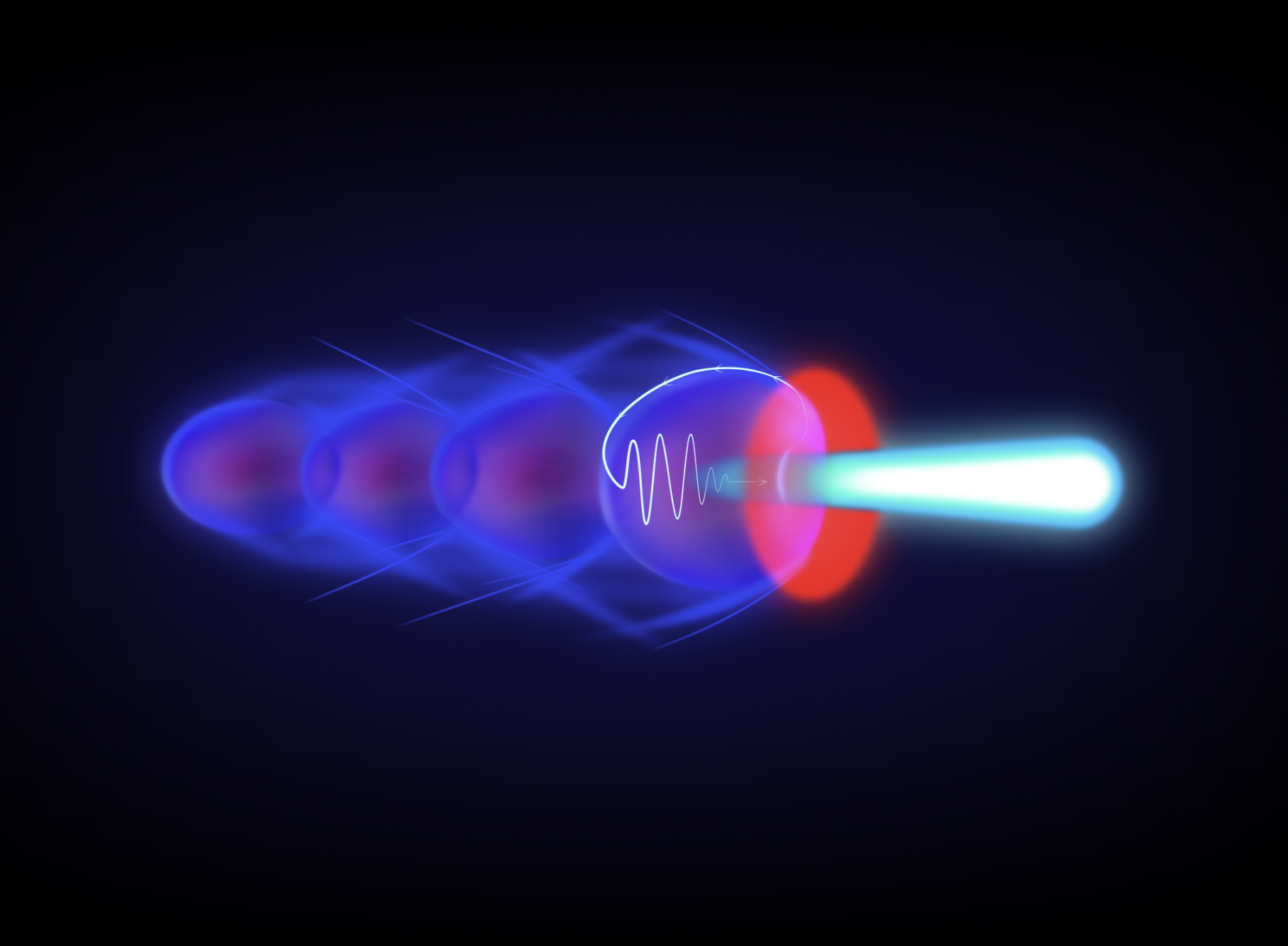
Plasma-based particle acceleration makes use of the fact that electric fields in plasma can be a thousand times stronger than in conventional vacuum devices.

This means that the same energy gain can be obtained over a distance a thousand times as short, potentially shrinking the size of the accelerating device dramatically. In most cases, a short, intense laser pulse drives a wave in low-density plasma, and the accelerated particles “ride” this wave to obtain high energy.

This process is mainly used to accelerate electrons, but can also be used for protons and heavier positive ions. An important application of accelerated electrons is the generation of X-rays, resulting from the transverse “wiggle” motion of the electrons during their acceleration. Accelerated protons and heavier ions also have numerous applications, ranging from diagnosing plasma waves to various medical applications.

Laser-plasma instabilities happen when an intense laser beam drives a plasma wave, while the plasma wave in turn modulates the laser pulse. When these two processes reinforce each other, an instability results, and both the laser modulations and the plasma wave grow simultaneously. Research into these processes is vital to laser-driven nuclear fusion (where they are damaging and should be suppressed), and also in Raman-amplification of laser pulses (where they are beneficial and should be enhanced).

High harmonic generation of laser light in plasma targets exploits the fact that plasma is the only medium that can withstand the impact of ultra-powerful laser pulses. As the power of the harmonic radiation is proportional to that of the driving laser pulse, high harmonic generation in plasma will provide a wide spectrum of X-rays with unprecedented power. These X-rays have a wide range of applications, mainly in cutting-edge non-destructive imaging techniques.

Other science

The preceding sections should not be taken as an exhaustive list of all the science that falls within the CLF portfolio. Other aspects include:

  • laboratory astrophysics: a field that utilises the abilities of intense lasers to carry out experiments that mimic astrophysical phenomena
  • nuclear physics and neutrons: since ultra-intense laser irradiation produces MeV ions and electrons, these particles can induce nuclear reactions and can create novel sources of neutrons
  • muons: these fundamental particles are related to electrons, but unstable, and it might be possible to produce these with ultra-intense lasers
  • exotic physics: the conditions that can be reached using ultra-intense lasers open the door to highly speculative experiments to look for unknown physics
  • strong field physics: at very high intensities, the electric field of the laser can become so large as to ‘rip apart’ the vacuum and create electron-positron pairs. Whilst such intensities are not yet accessible, the CLF’s high power laser facilities will be able to start studying physics related to this

Meet the team

Alex Robinson

Plasma Physics Group Leader

Alexander is a theoretical and computation plasma physicist (specialised in laser-plasma physics) based in the CLF, and leading the Plasma Physics Group (PPG)

Raoul Trines

Senior research scientist

Raoul Trines is a theoretical plasma physicist at the Central Laser Facility. He specialises in analytic and numerical studies of parametric instabilities in laser-plasma interactions, as well as laser-driven particle acceleration in plasma

Robbie Scott

UPLiFT Chief Scientist

Robbie’s work focuses on developing the science and technologies required to realise laser-driven inertial confinement fusion as a future clean energy source.